For many ambitious entrepreneurs, the initial draw of an LLC is the "Limited Liability" shield: the legal fortress designed to protect your home, your savings, and your family's future from the risks of business. Yet, thousands of business owners are unknowingly dismantling that fortress every single day.
The culprit is a dangerous status quo known as co-mingling funds.
Industry myths suggest that as long as you "track your expenses eventually," using one bank account for both personal and business transactions is a harmless convenience. This logic is not just flawed; it is a structural failure. In the eyes of the law and the IRS, if you treat your business bank account like a personal piggy bank, they will treat your business like a personal extension.
Stop Reacting. Start Engineering. It is time to treat your bookkeeping with the forensic precision it requires.
The Forensic Reality: What is Co-Mingling?
Co-mingling is the failure to maintain a distinct financial narrative between the business entity and the individual owner. It occurs when business revenue is deposited into personal accounts, or when personal liabilities: groceries, rent, or family vacations: are settled using the company’s capital.
From a small business accounting perspective, your bank statement is more than a list of transactions; it is a legal document. When you mix these funds, you create a "blurred" entity. This lack of separation signals to external auditors and the courts that the LLC is merely an "alter ego" of the owner, rather than a legitimate, separate operation.
Structural Failures: Why Co-Mingling is Dangerous
Operating without a clear financial boundary is a high-stakes gamble. If you are currently co-mingling, you are exposed to four primary risks:
1. Piercing the Corporate Veil
This is the most severe legal consequence. If your business is sued or faces debt collection, a creditor can argue to "pierce the corporate veil." If they prove co-mingling, a judge can rule that the LLC's liability protection is void. The result? Your personal assets: your home, car, and personal bank accounts: become fair game for business creditors.
2. Forensic Audit Red Flags
The IRS expects bookkeeping for the self-employed to be transparent and verifiable. Co-mingling is a primary trigger for forensic audits. When business and personal expenses are intertwined, the IRS often disallows legitimate business deductions because the documentation lacks "business purpose" logic. This leads to back taxes, hefty penalties, and interest.
3. Institutional Loan Denials
In 2026, lenders utilize sophisticated algorithmic precision to assess risk. If you apply for a business loan or a line of credit with messy, co-mingled books, you will be flagged as high-risk. Banks require a clean narrative of cash flow to prove the health of your enterprise. Without it, your "runway" for growth is cut short.
4. Financial Blindness
You cannot manage what you cannot measure. When your data is polluted with personal spending, you lose the ability to see your true profit margins. Professional bookkeeping services for small business are designed to provide strategic insight; co-mingling turns that insight into noise.
The Compliance Logic: How to Fix the Breach
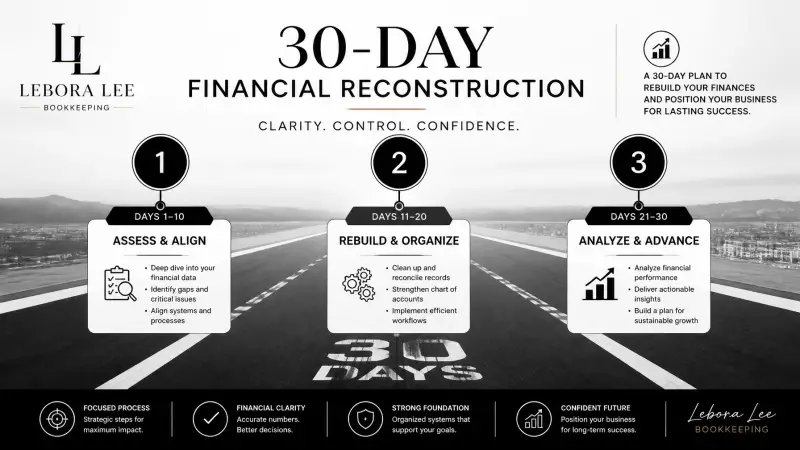
If your current books are a "chaotic narrative," you must begin the process of structural reconstruction. This is not merely a "cleanup" task; it is a strategic investment in the future-proofing of your company.
Phase 1: The Immediate Separation (Days 1-7)
The first step is a clean break. You must establish a dedicated business checking account and a business credit card. From this point forward, the logic is binary:
- Business Income/Expense: Goes through the business account.
- Personal Income/Expense: Goes through the personal account.
If the business needs to pay you, you must document a formal Owner’s Draw or distribution. If you need to fund the business, it is a Capital Contribution. No exceptions.
Phase 2: Historical Reconstruction (Days 8-30)
You must perform a forensic review of all mixed accounts from the beginning of the fiscal year. This involves:
- Categorization: Labeling every single transaction as Business or Personal.
- Logic Mapping: Creating "Adjusting Journal Entries" to move the personal expenses into the Equity section of your balance sheet as draws.
- Documentation: Storing receipts and invoices in a centralized, digital repository to support the business narrative.
Phase 3: Establishing the Framework
Future-proof your operations by implementing a recurring reconciliation process. Small business accounting is not a year-end event; it is a monthly discipline of stewardship.
How Lebora Lee Bookkeeping Engineered Your Solution
At Lebora Lee Bookkeeping, I don't just "do the books." I provide the financial framework necessary for ambitious entrepreneurs to thrive without the weight of compliance anxiety.
I specialize in historical clean-ups, taking the financial chaos of co-mingled accounts and reconstructing them into a forensic-grade record. My process ensures that every dollar is accounted for, the corporate veil is reinforced, and you are positioned for The Tax-Ready 2026 Initiative.
Whether you are a sole proprietor or a growing small business, my monthly bookkeeping services provide the reliability and peace of mind that come with knowing your books are solid.
The Bottom Line
Co-mingling is not a minor bookkeeping error; it is a fundamental threat to your legal and financial security. In the high-stakes environment of 2026, "getting to it later" is not a strategy: it is a liability.
Stop guessing. Start engineering.
If you suspect your accounts have become intertwined, the time for remediation is now. Protect your assets, secure your deductions, and gain the clarity required to lead your business with confidence.
Actionable Next Step:
Schedule a Free 15-Minute Financial Audit today. I will review your current account structure and provide a high-level roadmap to decouple your finances and restore your LLC’s protection.
Add comment
Comments